![Ivet-Logo_1.png]](https://trainerportal.ivet.edu.au/hs-fs/hubfs/Ivet-Logo_1.png?height=45&name=Ivet-Logo_1.png)
Simply click on the links below to quickly navigate to the section you want to view.
1. What is Reasonable Adjustment?
2. Your Obligations at a Glance
3. The Reasonable Adjustment Process
4. What You Can and Cannot Adjust
6. When an Adjustment Cannot Be Made
8. School and IVET Responsibilities
Appendix A: Condition-Specific Quick Reference
1. What is Reasonable Adjustment?
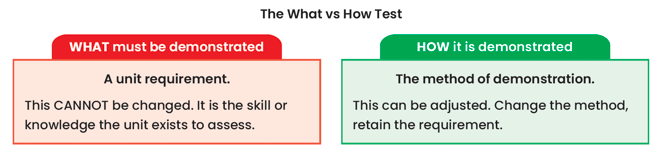
A reasonable adjustment levels the playing field; it does not lower the bar. It changes HOW a student demonstrates competency, never WHAT they must demonstrate. An adjustment that removes a unit’s requirement is not generous – it undermines the value of vocational education.
2. Your Obligations at a Glance
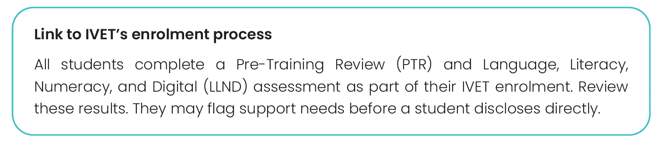
Under the Disability Discrimination Act 1992, disability includes any physical, intellectual, psychiatric, sensory, neurological, or learning disability, whether permanent, temporary, past, present, or future. A formal diagnosis is not required. What matters is the functional impact on the student’s ability to access training and assessment.
The Standards for RTOs 2025 (Outcome Standard 2.4) require that reasonable adjustments are made to support VET students with disability to access and participate in training and assessment on an equal basis. As the trainer delivering IVET’s programs in your school, you are the person best placed to identify needs, make adjustments, and document them. You must:
-
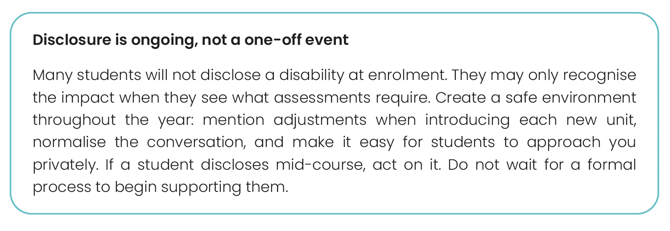
Support students in disclosing their disability, if they wish to do so, not just at enrolment but at any point during their course.
-
Make reasonable adjustments where appropriate.
-
Where adjustments are not possible, communicate the reasons to the student as soon as reasonably practicable.
-
Maintain the integrity of every unit of competency; all requirements must still be met.
Assessment must also meet the principles of assessment (fairness, flexibility, validity, reliability) and the rules of evidence (validity, sufficiency, authenticity, currency) under Outcome Standard 1.4.
3. The Reasonable Adjustment Process
IVET uses a range of assessment methods. Having a basic understanding of these as the course commences helps you identify potential needs for adjustment. Assessment methods used by IVET include:
-
Knowledge questions: multiple-choice, checklist, short and long-answer text responses completed in the IVET Portal.
-
Projects: extended tasks completed in various ways depending on the project. Methods include entering information directly into the IVET Portal, downloading and completing provided templates, or creating presentations.
-
Demonstrations: tasks students are observed completing
Specific assessment details are found in a unit’s Assessor Guide.
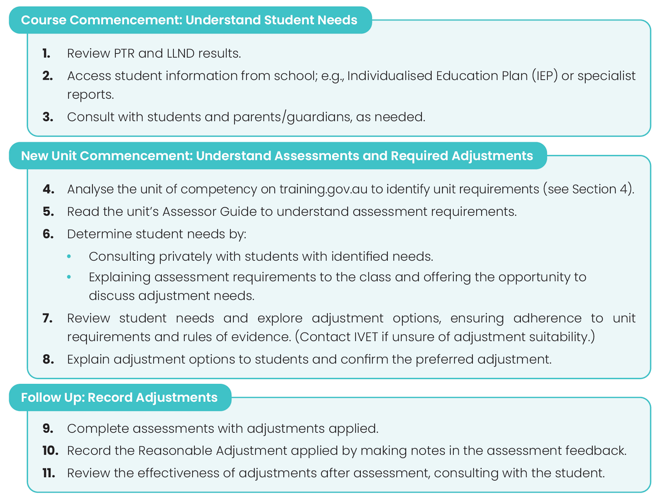
Follow these steps for every student who needs a reasonable adjustment. Most adjustments are straightforward and can be managed directly by you. For complex cases, contact IVET.
When to contact IVET
Most reasonable adjustments are straightforward and do not require IVET’s approval.
Contact IVET when:
-
The adjustment is complex, or you are unsure whether it compromises a unit’s requirement
-
The student’s condition affects multiple units, and a coordinated approach is needed
-
You believe the unit cannot be completed even with adjustment
- Extra time for a student with a diagnosed condition (e.g. ADHD, anxiety)
- A separate, quiet assessment environment
- Oral questioning where written expression is not a requirement
- A student with a temporary injury (e.g. broken arm) who needs to type rather than handwrite
If you contact IVET, include:
-
The unit(s) of competency and the specific assessment task.
-
The general nature of the student’s barrier (not the full diagnosis).
-
The assessment requirements you identified as problematic.
-
Your proposed adjustment(s) and reasoning.
Privacy and Consent
|
You need to know:
|
You do NOT need to know:
|
If a student chooses not to disclose, respect their decision and continue with planned assessments.
If contacting IVET, IVET does not need to know the student’s name or any other personal details – only functional context – how the student’s condition affects their ability to complete the assessment task.
4. What You Can and Cannot Adjust
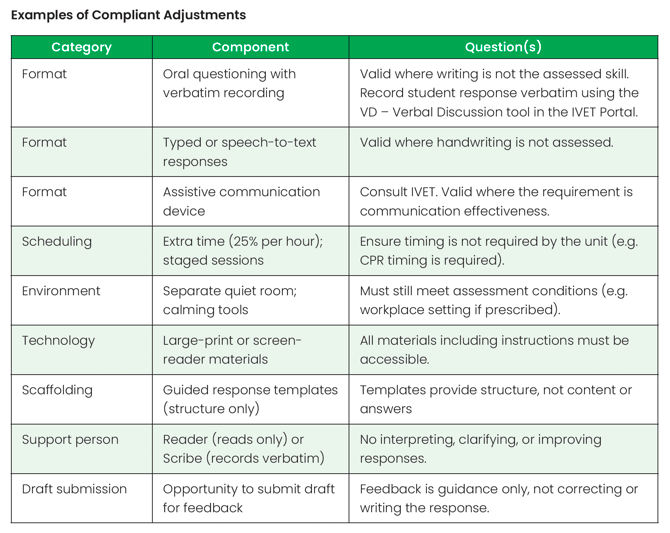
This is the most important section of this guide. IVET assessments are carefully mapped to unit of competency requirements. You cannot alter, modify, omit, or add to assessment tasks. A reasonable adjustment changes how the student accesses or demonstrates competency; it never changes what they must demonstrate.
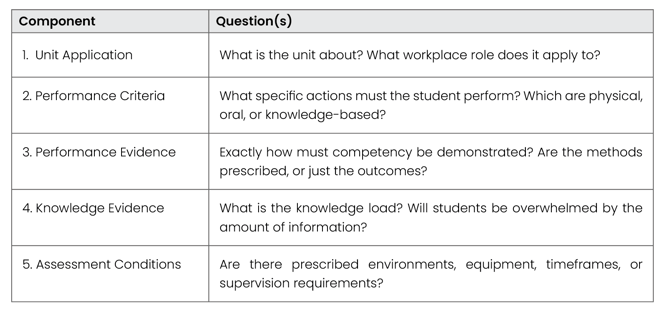
When checking a unit’s requirements, go to training.gov.au and review:
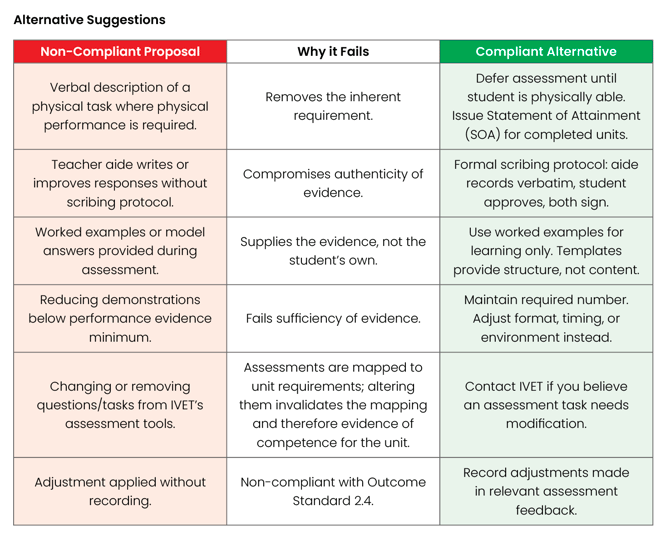
Non-Compliant Adjustments
An adjustment is non-compliant if it:
-
Removes a unit requirement.
-
Allows the student to avoid a mandatory skill or knowledge component.
-
Provides the answer or scaffolds beyond the student’s own work.
-
Changes WHAT must be demonstrated.
-
Compromises the validity, sufficiency, authenticity, or currency of evidence.
5. Recording the Adjustment
Recording the adjustment(s) applied to the assessment is mandatory.
Do this when providing feedback in the IVET Portal.
Record the following in each feedback comment:
-
What adjustment was applied
-
Why
-
Date and time of assessment
-
Notes on the effectiveness
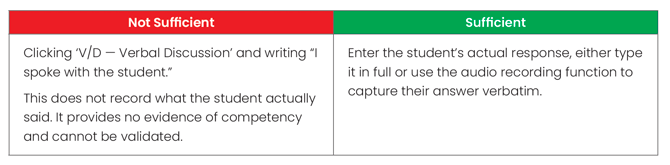
Using the IVET Portal Verbal Discussion Feature
When you conduct oral questioning as a reasonable adjustment, you must use the IVET Portal’s Verbal Discussion (VD) response feature. This is the most common adjustment IVET trainers make, and the most common area where recording falls short.
The VD record IS the assessment evidence. Without the student’s actual response, there is no evidence to support your competency judgement.
6. When an Adjustment Cannot Be Made
There are two reasons an adjustment may not proceed:
1. The adjustment would remove a unit requirement: If the proposed adjustment would mean the student does not demonstrate a skill or knowledge component fundamental to the unit’s purpose, it cannot proceed. Discuss these options with the student:
-
Deferral: is there a realistic timeline within which the student can meet the requirement?
-
Statement of Attainment: for units already completed. Frame this positively.
-
Alternative unit: do the packaging rules allow substitution with a unit the student can access?
-
Pathway conversation: support the student to make an informed decision about their options.
2. Unjustifiable hardship: Under section 11 of the Disability Discrimination Act 1992, an adjustment is not required if it would impose unjustifiable hardship. This is a very high threshold; not simply ‘expensive’ or ‘inconvenient.’ The burden of proof lies with the school. Examples might include an adjustment that creates a genuine safety risk to the student or others, or one with very high cost and very little benefit where an equal outcome could be achieved by less costly means.
7. Communicating the Decision
Where an adjustment is not appropriate or possible, the reasons must be communicated to the student as soon as reasonably practicable (Outcome Standard 2.4). In the VETDSS context, this means:
-
Discuss the decision with the student directly. Explain what was considered and why it cannot proceed. For students under 18, also inform the parent or guardian.
-
Inform the school VET Coordinator so they can align school-level support.
-
Where appropriate, inform the VCE Coordinator or Year Level Coordinator.
-
Document the reasons in writing and retain on the student’s training file.
-
Discuss alternative pathways (deferral, SOA, alternative unit) at the same time; do not leave the student without options.
Who else at the school needs to be informed will depend on your school’s policies and procedures. IVET does not necessarily need to be informed of every decision, but should be consulted where you are unsure about the unit requirements or the unjustifiable hardship threshold.
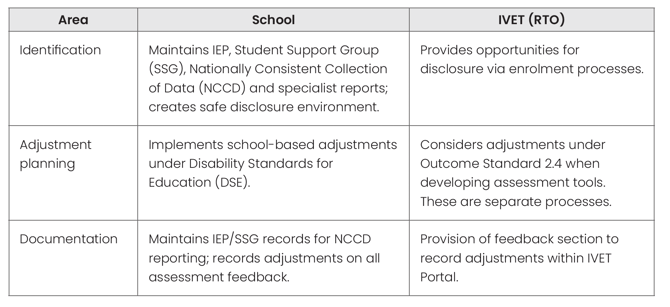
8. School and IVET Responsibilities
Reasonable adjustments in VETDSS are a shared responsibility. The school and the RTO each have distinct obligations.
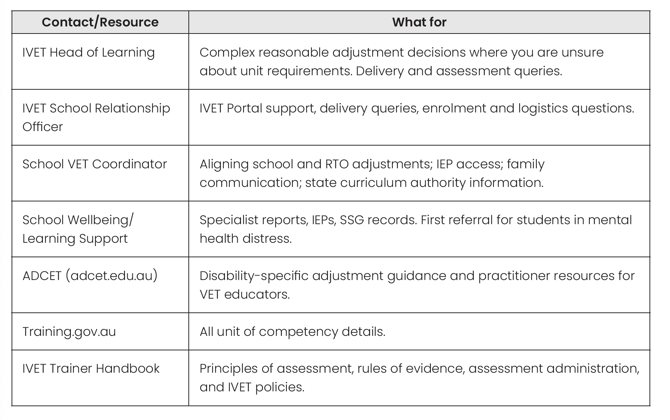
9. Where to Find Help
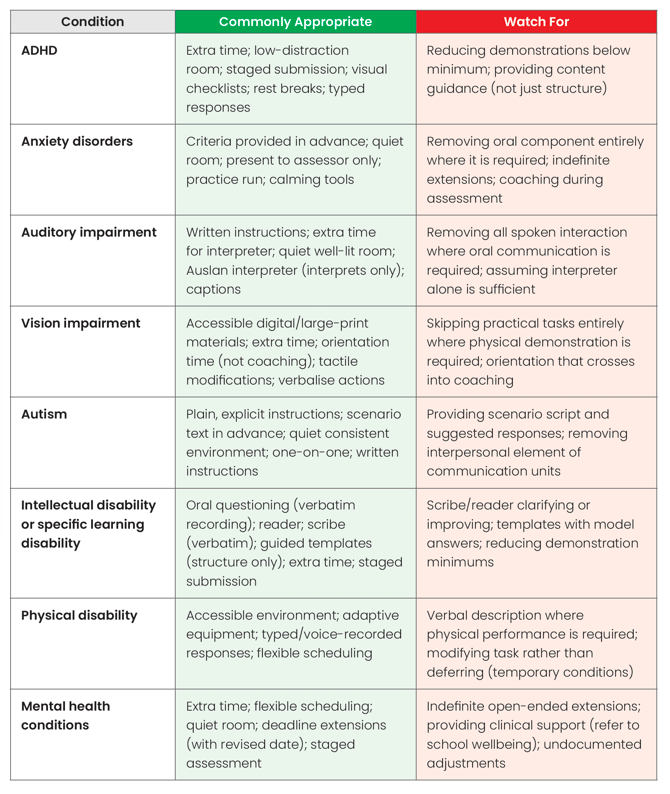
Appendix A: Condition-Specific Quick Reference
The table below summarises commonly appropriate adjustments and common risks by condition. For detailed guidance, refer to IVET’s supplementary condition-specific guides and ADCET (adcet.edu.au).
Appendix B: Worked Examples
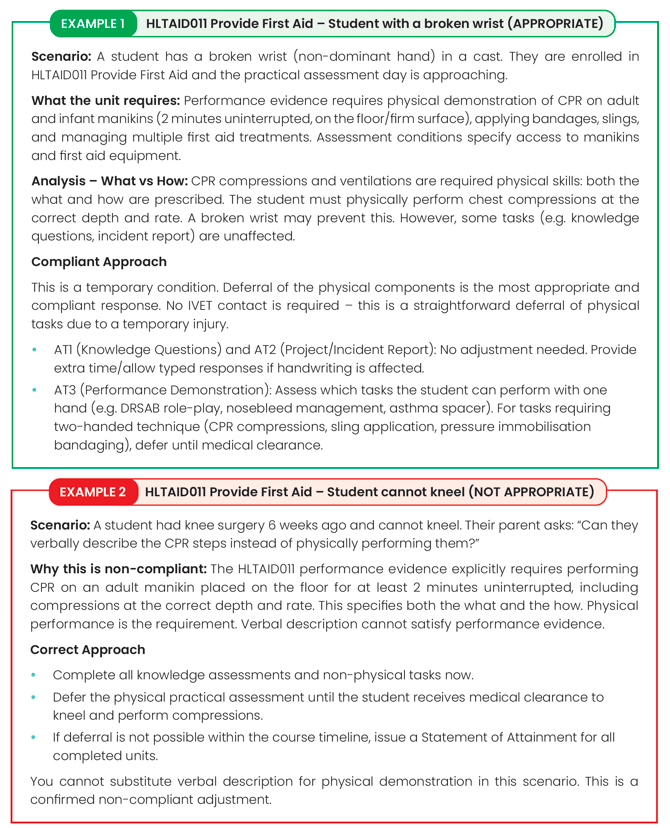
The following examples show how to apply the what vs how test and the adjustment process to real scenarios using IVET-delivered units. Each shows the student’s situation, what the unit requires, and the compliant approach.